
Spatial Structure and the Built Form of the Walled City of Lahore: Reading Street Hierarchy, Chowks, and Katraas as an Organizing System
DOI:
https://doi.org/10.68024/30vmra74Keywords:
Walled City of Lahore, Islamic urban morphology, street hierarchy, spatial organization, traditional urban formAbstract
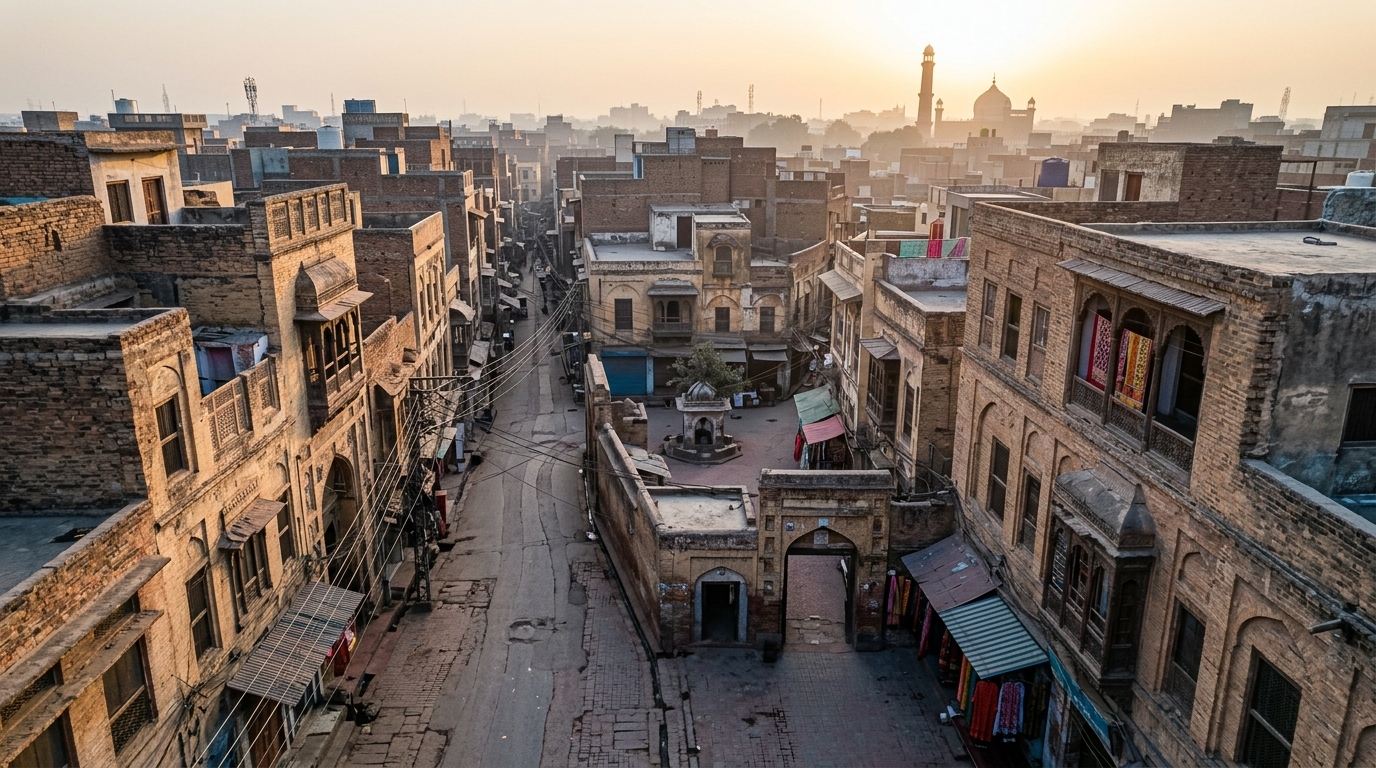
The spatial pattern of traditional Islamic cities is often perceived as an ad hoc process of development. This study examines the spatial form and fabric of the Walled City of Lahore (Androon Shehr) to identify the principles underlying its apparently complex urban morphology. It focuses on the relationship among street hierarchy, open spaces, residential and commercial blocks, and architectural form, with particular attention to guzars, koochas, galis, bund galis/katras, and chowks. Two guzars—Lohari Gate Bazaar to Lohari Mandi Chowk and Delhi Gate Bazaar to Pani Wala Talab Chowk—are examined alongside Katra Barkat Ali, Katra Sumer Singh, and five representative chowks: Matti, Bokhari, Jhanda, Lohari Mandi, and Wazir Khan. The findings indicate that the Walled City possesses a hierarchical and functionally integrated spatial order rather than an unstructured pattern. Guzars connect major gates and economic areas, while koochas provide access to residential neighborhoods. Galis and bund galis create progressively private and intimate spaces within mohallas. Chowks function as spatial nodes, social gathering places, landmarks, and points of urban permeability. Analysis of building heights and D/H ratios further demonstrates the intimate scale and spatial enclosure of chowks. The study concludes that the Walled City of Lahore represents a pedestrian-scaled urban environment in which movement, privacy, commerce, social interaction, and architectural enclosure are systematically integrated. Its apparently irregular morphology therefore reflects discernible principles of spatial organization rather than spatial chaos.
Downloads
Published
Issue
Section
License
Copyright (c) 2026 Uzma Kabir, Sannah Ejaz (Author)

This work is licensed under a Creative Commons Attribution 4.0 International License.
Articles published in this journal are licensed under the Creative Commons Attribution 4.0 International License (CC BY 4.0). This license permits others to share, copy, redistribute, adapt, remix, transform, and build upon the material for any purpose, including commercial purposes, provided that appropriate credit is given to the original author(s), a link to the license is provided, and any changes made are indicated.
Authors retain copyright of their work and grant the journal the right of first publication. The full terms of the Creative Commons Attribution 4.0 International License are available at https://creativecommons.org/licenses/by/4.0/.