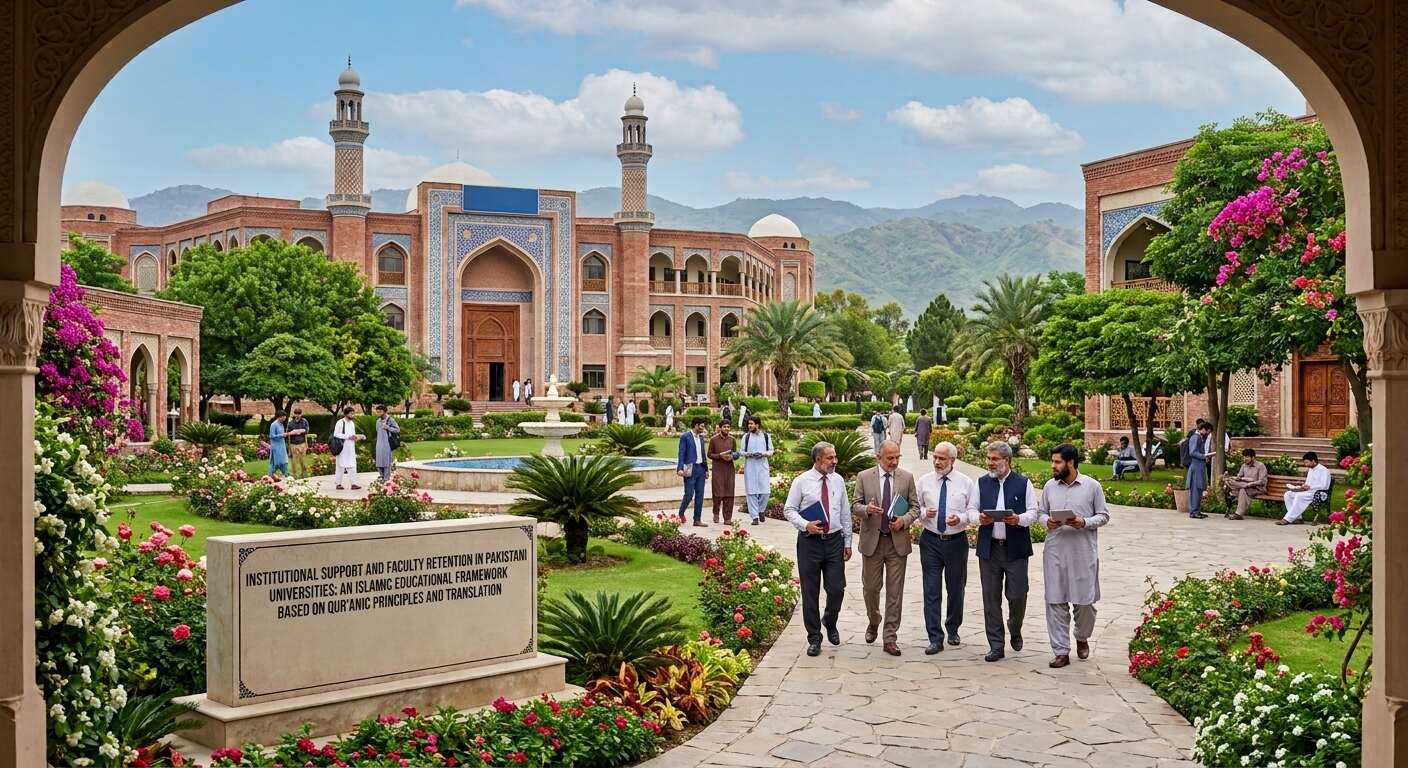
Institutional Support and Faculty Retention in Pakistani Universities: An Islamic Educational Framework Based on Qur’anic Principles and Translation
DOI:
https://doi.org/10.68024/n456t834Keywords:
Perceived Organizational Support, Faculty Retention, Islamic Educational Governance, Qur’anic PrinciplesAbstract
Faculty retention is a critical determinant of academic quality, institutional sustainability, and intellectual capital in higher education systems. While conventional higher education literature relies predominantly on Western paradigms—such as Social Exchange Theory (SET) and Perceived Organizational Support (POS)—these frameworks often reduce institutional governance to transactional dynamics. This study presents an integrated, Islamic educational framework that harmonizes POS with foundational Qur’anic principles of governance, justice, and human development. Specifically, it integrates the principles of `Adl (Justice), Iḥsān (Benevolence), Amānah (Trust and Responsibility), Shūrā (Mutual Consultation), and Ukhuwwah (Fraternal Solidarity) into institutional administration. Utilizing a quantitative, cross-sectional design, empirical data were gathered from faculty members across public and private universities in Pakistan ($N = 315$). Structural Equation Modeling (PLS-SEM) was conducted to examine the relationships among POS, organizational commitment, and faculty retention, framed alongside divine ethical mandates. The findings reveal that administrative practices grounded in justice and benevolence significantly enhance organizational commitment and mitigate turnover intentions. This paper offers a comprehensive, ethically grounded model for university administrators seeking to align modern human resource strategies with Islamic values.
Downloads
Published
Issue
Section
License
Copyright (c) 2026 Iram Arshad, Dr. Adeel Zafar, Dr. Ayaz Qaiser (Author)

This work is licensed under a Creative Commons Attribution 4.0 International License.
Articles published in this journal are licensed under the Creative Commons Attribution 4.0 International License (CC BY 4.0). This license permits others to share, copy, redistribute, adapt, remix, transform, and build upon the material for any purpose, including commercial purposes, provided that appropriate credit is given to the original author(s), a link to the license is provided, and any changes made are indicated.
Authors retain copyright of their work and grant the journal the right of first publication. The full terms of the Creative Commons Attribution 4.0 International License are available at https://creativecommons.org/licenses/by/4.0/.