Digital Code-Switching and Language Attitudes: A Mixed-Methods Study of English–Sindhi–Urdu Code-Mixing in WhatsApp Communication among University Students in Sindh, Pakistan
DOI:
https://doi.org/10.68024/t9mt2k09Keywords:
Digital Code-Switching, Multilingualism, WhatsApp Communication, Digilingual MarkednessAbstract
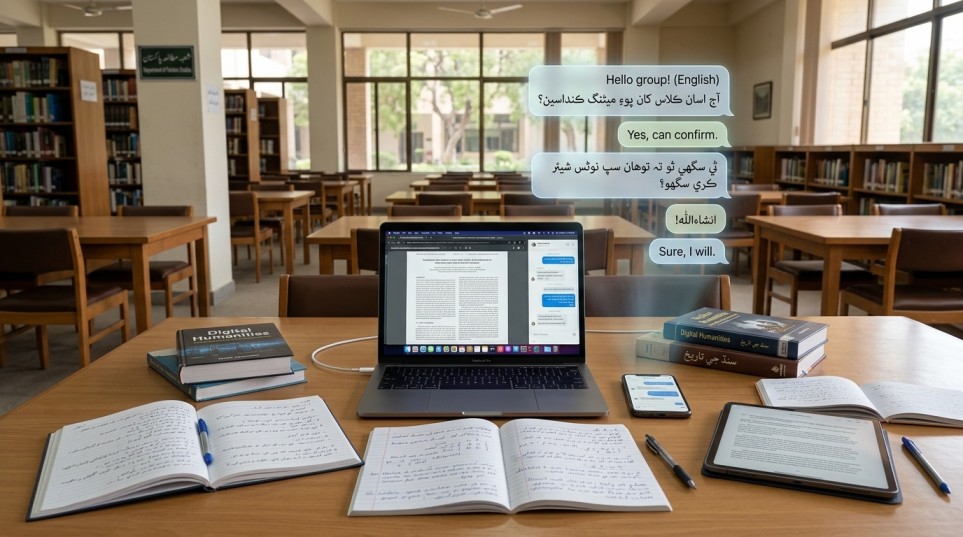
Mobile-mediated communication has reshaped multilingual practices in Pakistan, yet digital interaction among Sindhi university students remains under-researched. This study examines the frequencies, drivers, and attitudes regarding Sindhi–Urdu–English code-switching on WhatsApp among 280 postsecondary students in Sindh. Framed by Myers-Scotton’s Markedness Model, this convergent mixed-methods inquiry evaluated survey responses using SPSS (v26), alongside a 42,150-word chat corpus and 15 semi-structured interviews via NVivo (v14). Quantitative findings reveal Sindhi–English as the most prevalent combination (34.6%), followed by Urdu–English (29.3%) and trilingual integration (27.5%). Gender patterns show female participants switching predominantly for relational and identity functions, whereas male peers favor technical and topical switches. Overall, respondents expressed favorable attitudes, highlighting ease of communication and vocabulary bridging. Qualitative thematic synthesis yielded six core motivations: convenience, identity construction, peer solidarity, status, lexical gaps, and humor. The study contends that WhatsApp functions as a distinct sociolinguistic domain where youth perform a dynamic, technology-mediated identity that both resists and reinforces English-dominated linguistic hierarchies. To better explain digital language selection, the author proposes "digilingual markedness" as an extended adaptation of the Markedness Model. These insights provide significant contributions to sociolinguistic theory, educational policy, and English language pedagogy in Sindh.
Downloads
Published
Issue
Section
License
Copyright (c) 2026 Dr. Ali Siddiqui, Razia Hataf, Shamshad Junejo (Author)

This work is licensed under a Creative Commons Attribution 4.0 International License.
Articles published in this journal are licensed under the Creative Commons Attribution 4.0 International License (CC BY 4.0). This license permits others to share, copy, redistribute, adapt, remix, transform, and build upon the material for any purpose, including commercial purposes, provided that appropriate credit is given to the original author(s), a link to the license is provided, and any changes made are indicated.
Authors retain copyright of their work and grant the journal the right of first publication. The full terms of the Creative Commons Attribution 4.0 International License are available at https://creativecommons.org/licenses/by/4.0/.