Teachers’ Perspectives on Mobile Gaming: Academic, Behavioral, and Classroom Implications for Secondary School Students in Punjab
DOI:
https://doi.org/10.68024/fq2rh473Keywords:
Mobile gaming, secondary school students, teachers’ perceptions, classroom engagementAbstract
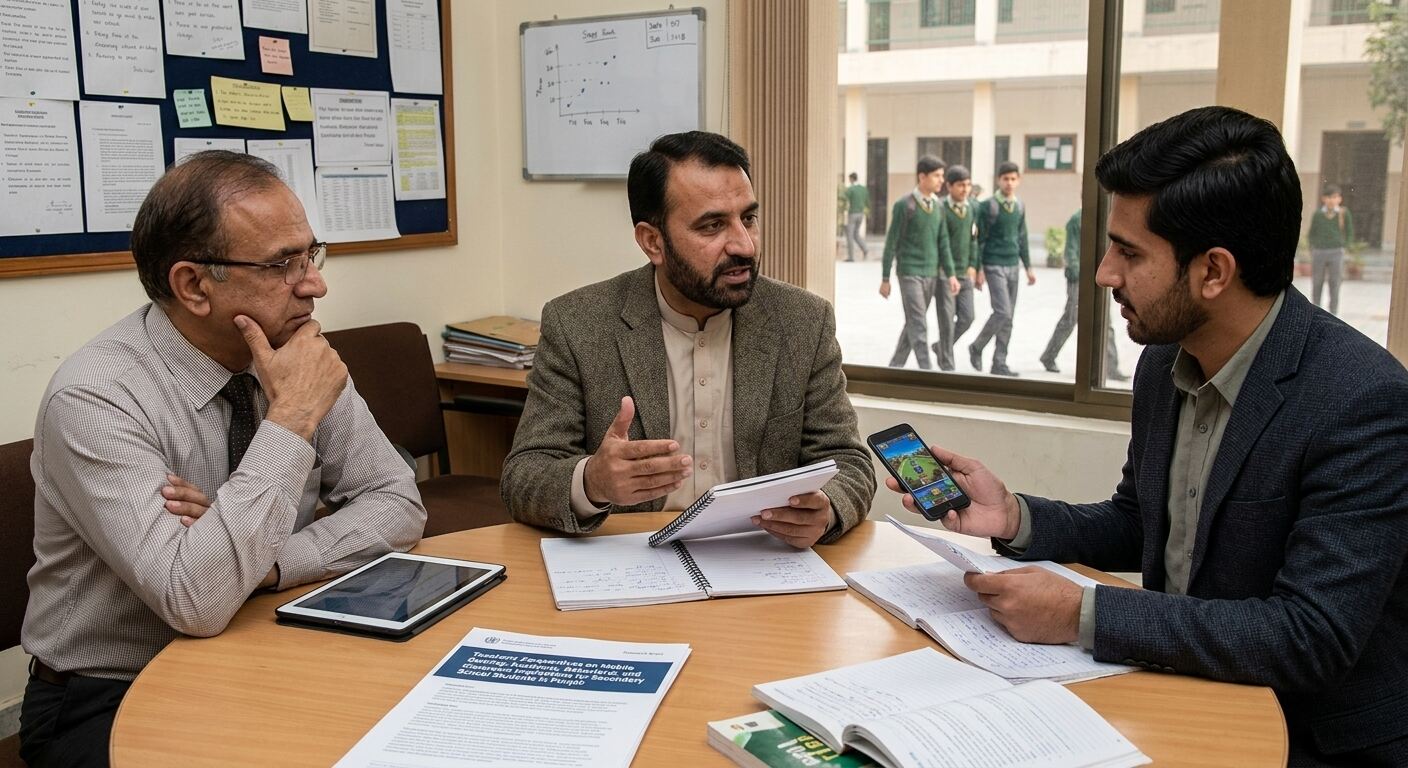
Mobile gaming has been popular with secondary school students, and this has raised questions about its effects on learning, behavior, and classroom participation. This study evaluated the perspectives of teachers on the academic, behavioral, and classroom effects of mobile gaming among secondary school students in Punjab, Pakistan. It reviewed teachers’ methods and school-level strategies for monitoring gaming and promoting balanced and appropriate usage of digital devices. The interpretivist paradigm was used to inform a qualitative research strategy. Purposive sampling was used to select thirty secondary school teachers who were chosen from selected public and private schools in Faisalabad, Lahore, and Jhang. Data were acquired via semi-structured interviews and analyzed thematically. Results showed teachers associated excessive mobile gaming with poor attention and interest in classroom activities, disrupted and irregular bedtime and rising times, irritability, distraction, problems with game engagement, and other behavioral problems. However, teachers also saw some benefits of moderate gaming, such as engagement and communication with peers, strategic thinking, problem-solving, and enjoyment. Teachers used monitoring, counselling, awareness exercises, time-management coaching, sports, and school policies to encourage the responsible use of digital devices. In general, the data imply that the consequences of mobile gaming mostly depend on how intensively it is used, on students’ self-regulation and on the advice provided by schools and families.
Downloads
Published
Issue
Section
License
Copyright (c) 2026 Hina Fatima, Dr. Muhammad Naeem Mohsin (Author)

This work is licensed under a Creative Commons Attribution 4.0 International License.
Articles published in this journal are licensed under the Creative Commons Attribution 4.0 International License (CC BY 4.0). This license permits others to share, copy, redistribute, adapt, remix, transform, and build upon the material for any purpose, including commercial purposes, provided that appropriate credit is given to the original author(s), a link to the license is provided, and any changes made are indicated.
Authors retain copyright of their work and grant the journal the right of first publication. The full terms of the Creative Commons Attribution 4.0 International License are available at https://creativecommons.org/licenses/by/4.0/.