Psycholinguistic Patterns of Security Narratives: International Relations Students and the Role of Pakistan Army in South Waziristan
DOI:
https://doi.org/10.68024/rtt7kv79Keywords:
Dera Ismail Khan, Plan Colombia, Algeria’s Civil War, Afghan War, Discourse AnalysisAbstract
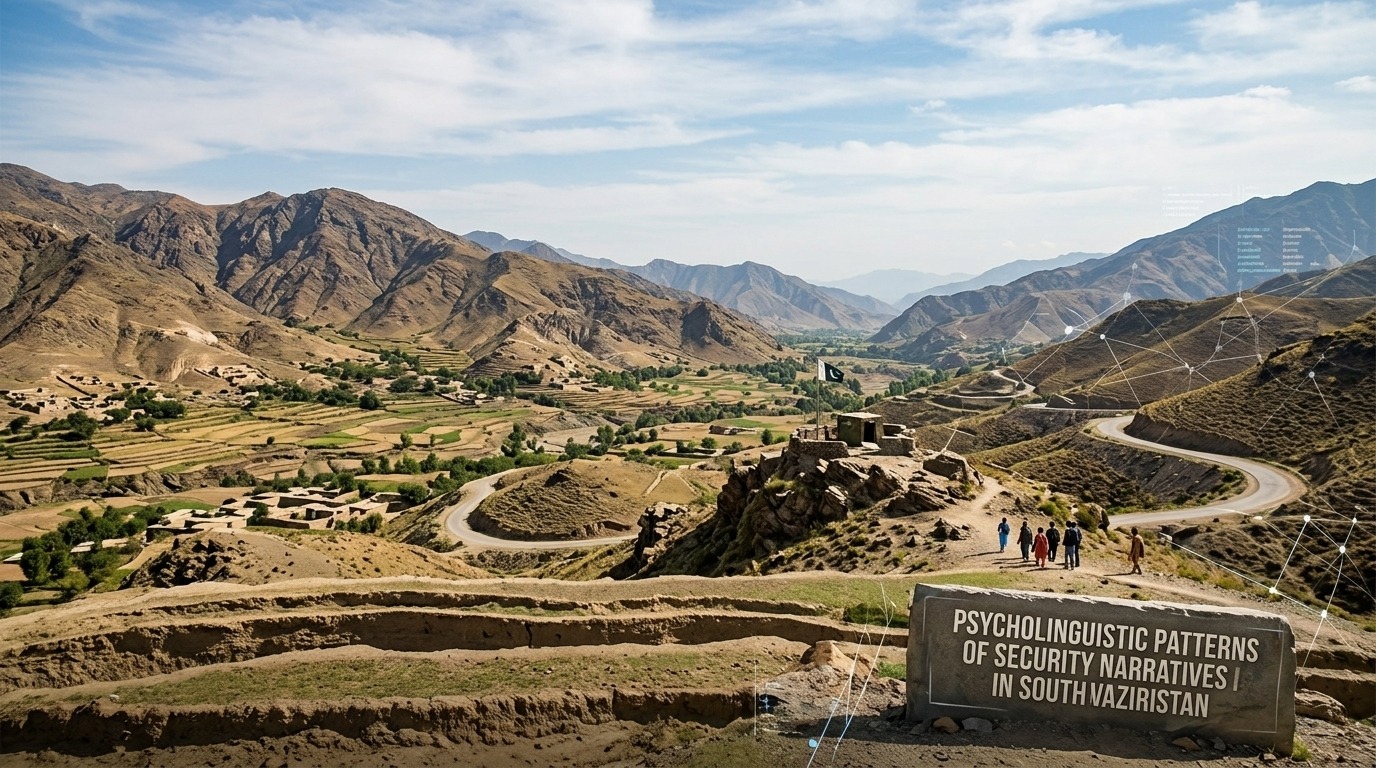
Since 9/11, South Waziristan has remained a turbulent region plagued by militancy, illicit economies, and fragile governance both before and after its merger with Khyber Pakhtunkhwa (KP). The Pakistan Army has played a central role in tackling these challenges through counter-insurgency operations, securitised governance, and reconstruction measures aimed at restoring stability and state authority. This paper examines the diverse narratives articulated by International Relations students hailing from South Waziristan but studying in leading Pakistani higher education institutions. These students construct comparative perceptions of the Pakistan Army’s socio-ethical interventions in South Waziristan in relation to the performance of other militaries globally in addressing similar insurgency-driven contexts. The recent literature provides a backdrop for interpreting student discourses. Findings show that compared with international cases—including Peru, Colombia, Algeria, Afghanistan, Iraq, Indonesia, Sri Lanka, Turkey, and the Philippines—local intellectuals and students appreciate the Pakistan Army’s effectiveness in stabilising South Waziristan, thereby assisting in investigating how securitised governance reshapes identity, legitimacy, and future governance pathways in Pakistan’s frontier regions.
Downloads
Published
Issue
Section
License
Copyright (c) 2026 Muhammad Aftab khan, Dr. Muhammad Asim (Author)

This work is licensed under a Creative Commons Attribution 4.0 International License.
Articles published in this journal are licensed under the Creative Commons Attribution 4.0 International License (CC BY 4.0). This license permits others to share, copy, redistribute, adapt, remix, transform, and build upon the material for any purpose, including commercial purposes, provided that appropriate credit is given to the original author(s), a link to the license is provided, and any changes made are indicated.
Authors retain copyright of their work and grant the journal the right of first publication. The full terms of the Creative Commons Attribution 4.0 International License are available at https://creativecommons.org/licenses/by/4.0/.