
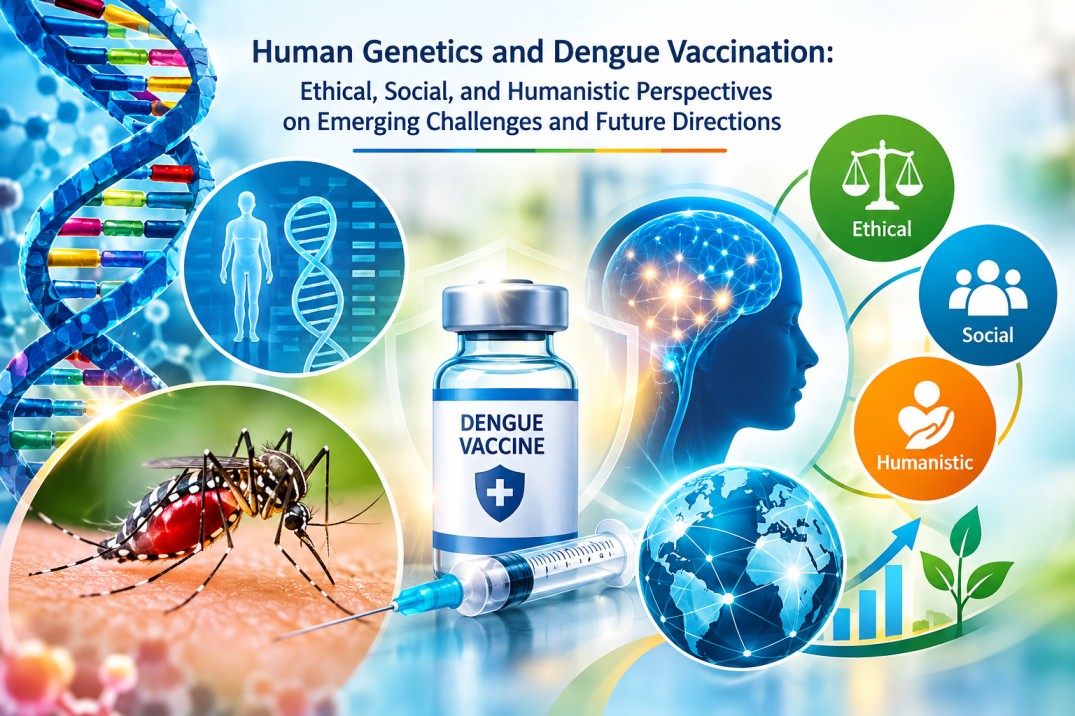
Human Genetics and Dengue Vaccination: Ethical, Social, and Humanistic Perspectives on Emerging Challenges and Future Directions
DOI:
https://doi.org/10.68024/x6f9yn65Keywords:
Dengue Vaccination, Host Genetics, Bioethics, Humanistic Perspectives, Health EquityAbstract
Dengue virus (DENV) infection presents a critical public health crisis across tropical and subtropical regions, including Bangladesh. While clinical manifestations range from mild self-limiting febrile illness to severe dengue shock syndrome, recent bio-medical frameworks highlight the interplay between host genetic variability and vaccine efficacy. Beyond immunological mechanisms, the introduction of dengue vaccines and genetic profiling introduces complex bioethical, social, and humanistic dilemmas regarding equitable access, informed consent, and health equity. This study explores the intersection of host genetic polymorphisms and dengue vaccination strategies, critically examining the ethical, social, and humanistic challenges arising from genomic risk stratification and vaccine deployment in low- and middle-income countries (LMICs). A comprehensive analytical and bioethical narrative synthesis was conducted, re-evaluating molecular epidemiological data alongside socio-ethical frameworks. Genetic variants governing immune regulation (e.g., TNF, IL6, IL10, TLR3, TLR4, FCGR2A, CD209, and MBL2) were analyzed in conjunction with vaccination dynamics, vaccine-induced antibody-dependent enhancement (ADE), and global bioethics guidelines. Genomic risk stratification promises personalized public health interventions but risks exacerbating health disparities, genetic discrimination, and social stigma. Integrating humanistic perspectives into dengue immunization policies is vital for safeguarding vulnerable populations, maintaining institutional trust, and ensuring bioethical integrity in national health frameworks.
Downloads
Published
Issue
Section
License
Copyright (c) 2026 Sajib Kumar Das, Preetikana Sarker, Shrestha Shreya (Author)

This work is licensed under a Creative Commons Attribution 4.0 International License.
Articles published in this journal are licensed under the Creative Commons Attribution 4.0 International License (CC BY 4.0). This license permits others to share, copy, redistribute, adapt, remix, transform, and build upon the material for any purpose, including commercial purposes, provided that appropriate credit is given to the original author(s), a link to the license is provided, and any changes made are indicated.
Authors retain copyright of their work and grant the journal the right of first publication. The full terms of the Creative Commons Attribution 4.0 International License are available at https://creativecommons.org/licenses/by/4.0/.